
Postpartum Doula vs Night Nurse vs Night Nanny vs Perinatal Support Worker: What Exhausted Parents Actually Need at 3 A.M.
Postpartum doula, night nurse, night nanny or Perinatal Support Worker? Here’s how the training and titles differ, and what overnight newborn help really involves.
Last updated October 2026
People often call us night nurses. We’re not nurses. We’re Perinatal Support Workers, and here’s what that means compared with the other roles you’ll see.
The short answer
- If you’re weighing a postpartum doula vs night nurse, you’ll find there are really four roles: a postpartum doula, a night nanny, a “night nurse” and a Perinatal Support Worker (PNSW), each with different training behind them.
- In Ontario, “nurse” is a protected title. Only a Registered Nurse (RN) or Registered Practical Nurse (RPN) can use it, so many “night nurses” are not nurses at all.
- At 3 a.m. the title matters less than the skills: knowing normal newborn behaviour, current safe sleep guidance and feeding logistics, and working without supervision.
- Why Parents Are Confused (And Why It Matters)
- Before you book anyone, ask about training hours, hands-on practice, insurance, background checks and CPR
By the time you’re Googling “night nurse alternatives” or “overnight newborn care” at 3 a.m., you’re probably running on caffeine fumes, adrenaline, and whatever leftover hope you still have in your soul.
And because the internet is both helpful and a bit of a mess, you’re probably seeing 14 different titles that all sound the same.
So let’s get honest, gently blunt, and a touch sarcastic, because the difference between a postpartum doula, a night nanny, a “night nurse,” and a Perinatal Support Worker isn’t just semantics. It’s what determines whether your night runs smoothly or whether you’re cleaning baby poop off the living room wall at 11 p.m. without backup.
Ask us how we know.
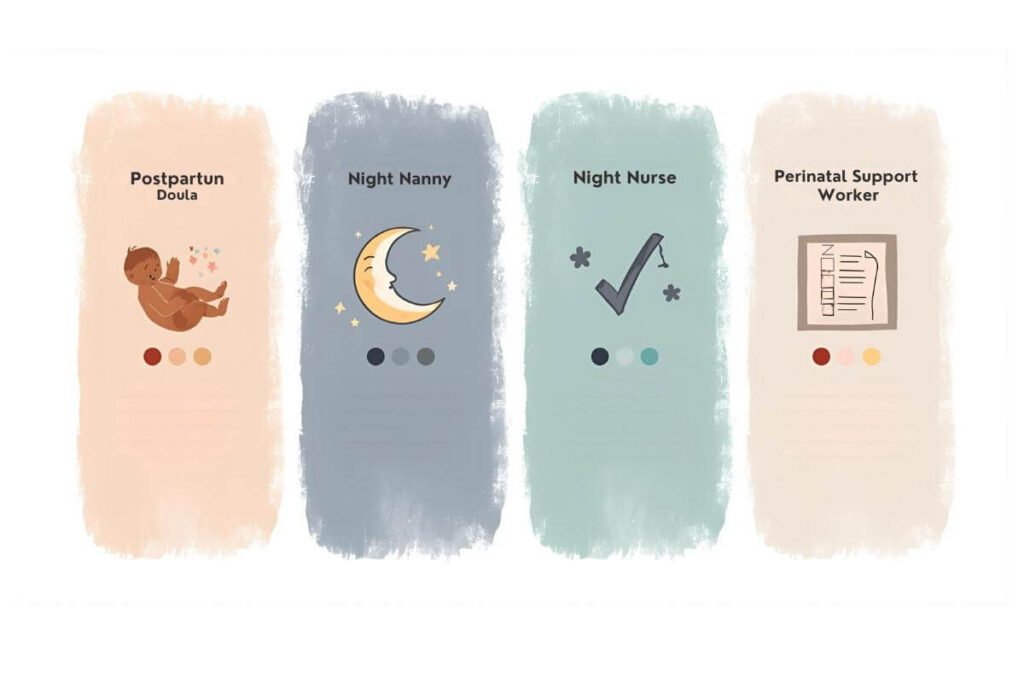
Postpartum doula vs night nurse: how do the four roles compare?
|
Role |
Typical training |
What to know |
|---|---|---|
|
Postpartum doula |
A certification course, often 15 to 30 classroom hours, with limited hands-on practice |
Quality varies a lot by person and by any additional training |
|
Night nanny |
No standard training |
Extra hands overnight, not necessarily current on safe sleep or feeding |
|
“Night nurse” |
Could be a nurse, but often isn’t and there’s no standardized training |
“Nurse” is a protected title in Ontario |
|
Perinatal support worker (PNSW) |
100+ classroom hours, up to 500 practicum hours, proctored exam |
Continuing education, insurance, background checks and CPR required |
Why are parents confused about these roles?
Most parents don’t ask us, “So what’s the difference between these roles?” They think they already know, or they assume we are whatever title their friend-of-a-friend used.
But here’s where things get messy: some of these roles are trained, some are loosely trained, some are mislabelled, and one of them is protected by law. (Spoiler: it’s “nurse.”)
And at 3 a.m., the differences matter. A lot.
What does each role actually do?
Postpartum doula
This is the standard postpartum training. Usually a weekend course, some book reports, an open-book exam, and basic support education. There are some phenomenal postpartum doulas out there who go on to do additional training and really focus on their areas of expertise. We love working with people who know they can never know it all, who are focused on getting better, and who want to bring their best.
Night nanny
This is basically a nanny who works at night. They’re not necessarily trained in newborns, not necessarily current on safe sleep or feeding guidelines, and not necessarily there to provide education. Just hands.
They can be lovely humans, and they can be amazing at their job. They can also not know how to safely prepare formula or keep a swaddle from coming undone. (Again, ask us how we know.)
“Night nurse”
In Canada, and many States, “nurse” is a protected. Most people using “night nurse” are not Registered Nurses (RNs) or Registered Practical Nurses (RPNs) at all, and truthfully aren’t actually calling themselves that at all. Its often a title given to them by others.
Even if someone is an actual nurse, hospital experience doesn’t automatically translate to supporting healthy newborns in a home at 3 a.m. Different skills, different environment, different needs. Nurses are trained for medical care and assessment. Postpartum support in homes requires expertise in normal newborn behaviour, feeding support, sleep patterns, and family education, which isn’t the primary focus of nursing training.
Perinatal Support Worker (PNSW)
This is the most comprehensive in-home support training we know of in Canada. We’re talking over 100 in-class hours, up to 500 practicum hours, and coverage of everything from fertility and pregnancy to postpartum recovery, sleep, infant care, feeding, mental health, and how all the pieces fit together. There’s a proctored exam, required continuing education, insurance requirements, background checks, and CPR certification.
This is where our team at Cradira Support sits. Currently, both of us are PNSWs. Down the road, we’ll probably have postpartum doulas on our team as well, because we know great people come from all kinds of training backgrounds. But PNSW is our foundation.
We’re not there to simply hold a baby. We’re there to support you, educate you, keep things safe, and help you create the routines you’ll want to maintain long after we’ve left your house.
What do parents actually need at 3 a.m.?
You think you need someone to “take the baby.” You actually need someone who knows how to troubleshoot, knows what’s normal versus concerning, knows how to find evidence-based answers if they don’t know something on the spot, and can calmly walk into a situation and say, “Okay, here’s what’s happening.”
You need someone who understands Canadian Paediatric Society safe sleep guidelines, doesn’t need supervision, doesn’t create more work for you, and won’t wake you at 2 a.m. asking where the bottles are.
You don’t need a warm body. You need expertise.
And as we always say at least once a client: “How you feed your baby isn’t our call. Not our body, not our baby, not our choice. We’re only asking because it changes how the night looks.”
What does the difference look like in real life?
The night nanny story
We once had a client in Mississauga who hired a night nanny because she cost less and came highly recommended. Four weeks later? Fired. She wasn’t unsafe, but she wasn’t current on feeding guidelines, wasn’t confident troubleshooting fussiness, and wasn’t providing education. This meant the parent was awake half the night worrying anyway.
When the client hired us instead, it took just one shift to show her the difference. There was calm, there was education, there was troubleshooting based on our PNSW training. And most importantly, there was sleep.
The Poopocalypse
One of us had a shift in Toronto that’s now legendary. Picture this: baby pooping like a lawn sprinkler, diapers stacking like a Jenga tower, trying not to wake the toddler, whisper-laughing because it was either laugh or cry, bathing the baby in the sink, then cleaning the floor when the sink overflowed during tub draining.
A total chaos gremlin moment. And the parent didn’t have to manage it alone, because we were there with the training and experience to handle it calmly.
That’s the difference.

What does overnight support look like with Cradira?
We show up at night in yoga pants, a t-shirt, Crocs, with a reusable water bottle and our lunch in the fridge. And we start by asking: “How are you doing? How was today? What do I need to know?”
And when you’ve wound down, talked through your worries, and your shoulders drop two inches, we say: “You should go to bed.”
If you’re bottle-feeding, we handle the night. If you’re chestfeeding or pumping, we handle everything around the feeding so you get maximum sleep. We wash pump parts, prep and clean bottles, track feeds and diaper outputs, provide support and education, and troubleshoot using evidence-based approaches.
We don’t cook, clean your house, or hold your baby for 10 hours straight. Why? Because we help you create habits and an environment you can maintain when we’re not there. Also, sitting awake all night in a dark room listening to white noise is unsafe for us and unrealistic for you. Overnight care needs rest rotations to work well.
And yes, we bring our own indoor shoes.
See the full details on our overnight postpartum support page.
Where does daytime support fit in?
Overnight support is where most families start, but it isn’t the whole picture. We also provide daytime postpartum support: structured routines, day environment optimization, nap strategies, daytime troubleshooting, and everything that connects daytime patterns to nighttime success.
Our Perinatal Support Workers have the same comprehensive training whether they’re with you at 3 a.m. or 3 p.m. Which shifts we offer depends on your needs and our availability, and many families combine both.
What is our approach, and who do we work with?
Here’s our stance: it’s not our baby, it’s not our life, it’s not our choice. So long as what you’re doing isn’t unsafe, we don’t get to judge, and we wouldn’t want to. You can feed your baby however you want and take any parenting approach you’d like. We’re there to support you, make it easier, and give you information, tips, and tricks that smooth the way.
Our typical client is usually a double-income family where one or both parents are going back to work fairly quickly. Many of our birthing parents work in roles where taking a year of leave isn’t viable. Maybe they own their own business or practice, maybe they’re executives, maybe they’re worried about maintaining clientele or are simply devoted to their work. Many are looking for a more structured approach to sleep and parenting.
While understanding that babies are babies and can’t be controlled, we focus on loosely structured routines that help families meet their goals, cater to their personalities, and allow babies to be babies. Needs met, personalities respected.
That said, we work with all different family structures. Sometimes we’re there to replace overnight help for a partner in a highly demanding job who can’t afford to be up frequently. Sometimes we’re there to ease the stress of doing this for the first time without knowing where to turn. Sometimes we’re there to take over all night so people can sleep and be better parents during the day.
A green flag: “I want to try this feeding method, but I’m open if it doesn’t work.”
A red flag: “This is what I’m doing and I won’t consider anything else.”
We don’t work with families who bed-share, simply because our training and approach don’t align with that choice based on Canadian Paediatric Society safe sleep guidelines. We also don’t work with people who need every detail done “their way or else,” or who want to squeeze every penny of “value” out of us like we’re a gym membership they never use.
Is overnight newborn help worth it?
Yes, with nuance. Not everyone needs it. Not everyone wants it. And we’re not for everyone.
But if you’re overwhelmed, exhausted, want education instead of just babysitting, want someone who will support your choices, want safety and up-to-date care and calm, or want the insurance policy of “if tonight goes sideways, I don’t have to manage it alone,” then yes. It’s worth every penny.
Because the value isn’t in the easy nights. It’s in knowing that if everything goes sideways, you don’t have to handle it alone.
How much does overnight newborn care cost in the GTHA?
We charge a flat hourly rate based on location and number of babies, for around $48 an hour. Contact us for a custom quote. We’ll tailor it to your family’s needs.
Where do we support families?
We work across Toronto and the GTHA, including North York, Etobicoke, Scarborough, Vaughan, Woodbridge, Bolton, Brampton, Mississauga, Oakville, Milton, Stoney Creek, and Hamilton. See our local pages for Toronto, Brampton, and Hamilton and Stoney Creek.
What if in-home support isn’t the right fit right now?
You don’t have to choose between a night nurse and doing it all alone. Here is a way to start at any budget:
Add in-home support when you want hands in the house.
Take the free time quiz to see where your hours will actually go with a newborn.
Use the Household Systems Guide to get shared information, routines and handovers out of one person’s head.
Book virtual postpartum support for help applying it to your actual household.
If you’re reading this at 3 a.m.
You don’t have to do this alone. Whether you work with us or not, you deserve clarity, confidence, and support that doesn’t make you feel like you’re failing.
If you’re thinking, “this sounds like what we actually need,” reach out through our Contact page.
If you’re thinking, “I can’t afford this but I want education or virtual support,” start with the free quizzes or virtual support.
You can also explore all of Cradira Support or check our FAQs.
We’re here. And you’ve got this, even if tonight looks like a total mess.

Frequently asked questions
What is the difference between a postpartum doula and a Perinatal Support Worker?
A postpartum doula usually completes a certification course of roughly 15 to 30 classroom hours. A Perinatal Support Worker completes 100+ classroom hours and up to 500 practicum hours, plus an exam, continuing education, insurance, background checks and CPR.
Can someone call themselves a night nurse?
In Ontario, “nurse” is a protected title. Only a Registered Nurse or Registered Practical Nurse can use it. Ask any “night nurse” for their registration.
Do I need overnight help if I’m bottle-feeding?
Not necessarily, but it can help. If you’re bottle-feeding, we handle the night. If you’re chestfeeding or pumping, we handle everything around the feeding so you get maximum sleep.
Does overnight support include housework?
No. We don’t cook or clean your house. We focus on baby care, feeds, education and helping you build routines you can keep going after we leave.
How much does overnight newborn care cost in the GTHA?
Our rate start around $48 an hour, depending on location and number of babies. Contact us for a custom quote.