
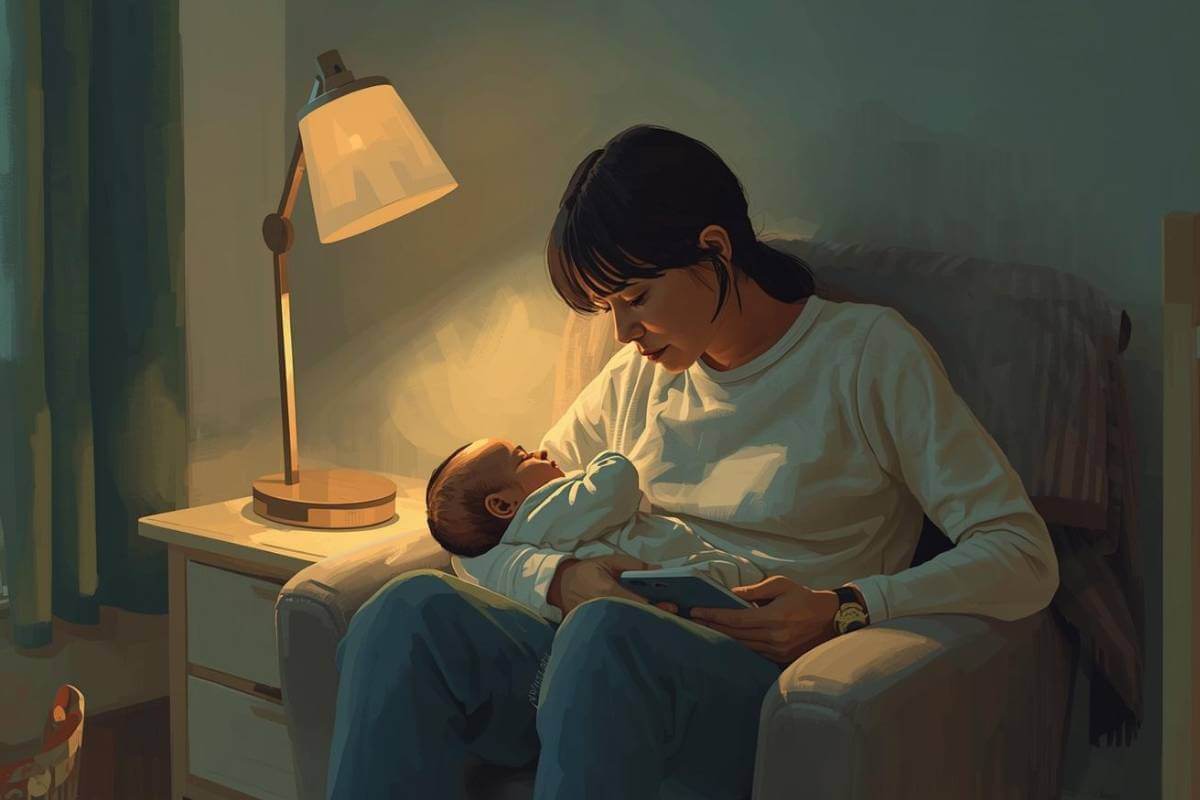
Postpartum Burnout Isn’t Normal. We Just Normalize It.
Postpartum burnout is common, but it isn’t normal. After calling feeling worse “fine,” one of us ended up in the ER. Here’s what depletion looks like and how to prevent it.

A few weeks ago, I ended up in emerge with a hemoglobin of 63.
For context, normal is somewhere between 120 and 160. Mine was 63. The staff were concerned. Which, if you’ve ever been in an emergency room, is the moment you realize this probably didn’t start today.
Here’s the part that matters. I wasn’t surprised enough.
I knew I was tired. I knew my arms felt like sandbags. I knew that walking from my bedroom to the kitchen, in a bungalow maybe twenty feet across, felt like more effort than it should. I needed breaks to make food. The thought of going downstairs to do laundry was completely beyond me. I had been napping constantly and waking up just as exhausted.
I knew all of that.
And I still told myself it was probably fine.
Because I was stressed. Because we were in the middle of a move. Because I already knew I was a bit anemic and figured some over-the-counter iron would handle it. Because there was a lot going on and I didn’t have time to fall apart. Because, if I’m being honest, I didn’t think my symptoms were serious enough to justify the fuss.
That last one is the one worth sitting with.
Because this is exactly how postpartum burnout happens. Slowly enough that you stop noticing.
Between us, we’ve spent close to 35 years sitting with new parents in the earliest weeks of their lives saying the same thing over and over:
Exhaustion is common.
It is not supposed to be permanent.
Burnout is not the price of loving your baby.
We believe it completely.
And still. Here I am.
Which tells you something important about how deeply this culture runs.
There is an unspoken story about what new parenthood is supposed to look like.
Good parents are exhausted.
Good parents push through.
Good parents don’t complain or ask for help unless things are falling apart.
If you’re managing, you’re probably not doing enough.
If you’re not running on fumes, you must have it too easy.
That story is a lie. A well-intentioned, deeply normalized, very persistent lie.
And it’s the reason many parents don’t realize something is wrong until they are already deeply depleted.
Burnout is not the definition of a good parent. Martyrdom is not a parenting strategy. Feeling terrible for weeks on end is not just what you sign up for when you have a baby.
If you do feel terrible for weeks, to the point where basic tasks are overwhelming you, something may actually be wrong. Possibly wrong with your body. Possibly wrong with your support system. Possibly both.
We’ve written before about how overwhelming the first six weeks can feel, and the part that doesn’t get said enough is that “overwhelming” and “I might actually need help” can look identical from the inside.
That’s what happened to me. I didn’t wake up one day at a hemoglobin of 63. I got there slowly, and I adjusted to it the whole way down.
The same pattern that kept me from addressing what was actually wrong is the exact pattern we see in families all the time.
It also made me think about something less dramatic, but just as practical.
What if I had been alone?
Not emotionally alone. Literally alone. What if no one knew where my medical information was? What I was taking? Who to call? What mattered? What needed to happen next?
I am private about my health and my life. Very private. And that has not always been simple for the people around me.
Privacy can get complicated inside a family. People can assume that needing privacy means rejecting their help, their input, or their concern. And sometimes, when you are the private person, you can convince yourself that needing help means you have to hand everyone full access to everything.
Neither has to be true.
Getting support does not mean completely exposing yourself. And keeping boundaries does not have to mean leaving everyone in the dark.
That was part of the reckoning for me. Important information can be available without being casually available. It can live in a folder, on a device, behind a password, or in a place someone trusted knows how to access if they truly need it.
Not floating around the family group chat. Not open for commentary. Just available if something happens.
I kept coming back to that question: if something happened, would the people trying to help me know what they needed to know? And the longer I sat with it, the more familiar it felt. Because we see a version of this in postpartum all the time.
Every household has systems, even if nobody calls them that.
Sometimes the work is divided by interest. Sometimes by skill. Sometimes by schedule. Sometimes by who hates a task the least. Sometimes one person holds certain information because it feels easier, faster, safer, or more comfortable that way.
No judgement. Most families are not sitting around designing household operations. They are just getting through the week.
Then a baby arrives.
Suddenly the system that mostly worked before does not work the same way anymore. There are more decisions, less sleep, more information to track, and far less margin for one person to be the only one who knows how everything runs.
That was part of where our Household Systems Guide came from. Not from a love of forms for the sake of forms. From realizing that support works better when the right information can be shared, without everyone needing access to everything all the time.
And from realizing that sometimes the thing we are embarrassed to say out loud is the exact thing another family needed someone to name first.

Why postpartum burnout is easy to miss.
The normalization of suffering.
The assumption that asking for help is indulgent.
The belief that needing rest means you’re falling short somewhere.
The quiet competition to be the parent who manages the most on the least.
Postpartum culture has its own version of this, where the narrative centres on how hard it is and how you just have to get through it.
Which means parents show up exhausted, depleted, struggling to function, and assume they’re doing it right.
Nobody flags it. Nobody asks. Because it looks exactly like what everyone expects new parenthood to look like.
This is part of why postpartum loneliness is so widespread. When suffering is normalized, nobody thinks to reach out.
There is a difference between normal adjustment and actually not being okay. That difference matters.
If your body is telling you something, it’s worth listening to.
And sometimes listening means talking to a medical professional, not just pushing through.
The support myth: why one person isn’t enough.
When we talk about postpartum support, we almost always mean “the partner.”
The person you made the baby with.
But recovery rarely works that cleanly.
The other thing that kept things from getting worse for me was the people around me.
My business partner Nat quietly kept the wheels on the bus. Family stepped in too. Groceries got handled. Meals got covered. Nobody made it dramatic. They just filled the gaps.
Not everyone has that built in.
But support isn’t assigned. It’s built.

Support can be a postpartum professional who handles overnight support so you can sleep. It can be a friend who takes the baby for two hours on a Tuesday. A sibling who does a grocery run. Delivery apps when leaving the house is not realistic.
If you’re pregnant, this is the time to decide who covers meals, sleep, and decision-making before you are too tired to plan.
Want to see where your hours will go before baby arrives? Take the free Time Quiz.
Support is practical, not romantic.
What to do before depletion becomes a crisis.
One of the hardest parts of gradual depletion, whether physical or emotional, is losing perspective on your baseline. You adjust to each step on the way down.
That’s when someone asking, “Are you sure you’re supposed to feel this way?” matters.
If someone asks, take it seriously. If you keep explaining your symptoms away, get it checked.
If what you’re feeling is emotional, not just physical, it’s worth knowing that you don’t have to figure that out alone. Organizations like Postpartum Support International exist specifically to help families understand what’s normal adjustment and what might need more support.
Not because you’re dramatic.
Because feeling awful for weeks is information.
Build the support system before you need it desperately.
Take the easy option when it’s available.
Let people fill the gaps.
Exhaustion is common. It is not a requirement.
You don’t need to earn rest by collapsing first.

If this sounded familiar, please don’t wait until things feel urgent.
Not sure where to start?
- Need hands in the house? That’s what Cradira Support is for, including overnight support.
- Take the free Time Quiz or House Quiz to see where your hours and household systems are likely to strain.
- Use the Household Systems Guide to get the information, decisions and backup plans out of one person’s head.
- Book a virtual call if you want to talk it through with someone who gets it. The “Now What” Call is built for exactly that.
What does postpartum burnout feel like?
Postpartum burnout can feel like constant exhaustion, overwhelm, irritability, brain fog, emotional flatness, or feeling unable to manage basic daily tasks. It can overlap with physical depletion, sleep deprivation, mental health concerns, or lack of practical support.
Is postpartum burnout normal?
Postpartum burnout is common, but that does not mean it should be ignored. If you feel awful for weeks, are struggling to function, or feel unlike yourself, it is worth reaching out for medical, emotional, and practical support.
What helps with postpartum burnout?
Rest, medical care when needed, shared household responsibilities, protected sleep, practical help, and clear support systems can all help. The goal is not to do more perfectly. The goal is to stop one person from carrying everything alone.