
A DIFFERENT WAY TO RUN YOUR HOUSEHOLD
Make fewer decisions. Make help easier to use.
The Household Systems Guide is a self-directed resource for expecting and new parents, partners, co-parents and support people. Available as a downloadable PDF or paperback, it helps you make household information easier to find, turn repeated decisions into practical defaults and set up systems more than one person can use.
Built for postpartum.
Useful long after it.

A DIFFERENT WAY TO RUN YOUR HOUSEHOLD
Make fewer decisions. Make help easier to use.
The Household Systems Guide is a self-directed resource for expecting and new parents, partners, co-parents and support people. Available as a downloadable PDF or paperback, it helps you make household information easier to find, turn repeated decisions into practical defaults and set up systems more than one person can use.
Built for postpartum.
Useful long after it.

35+
years combined experience
Hundreds
of families supported
Whole
household approach
Use it
your own way
Most households don’t struggle because people don’t care.
They struggle because everyday life asks people to keep finding information, making decisions and coordinating how things work, even when no one has much capacity left.
Information is scattered across phones, inboxes, cupboards, calendars and people’s memories. Small decisions are made again and again. When someone offers to help, getting them up to speed can become one more job for a household that is already stretched.
Finding
Where is the thing? What’s the plan? Who knows?
Information scattered across phones, papers, drawers, apps and people’s memories creates unnecessary searching and checking.
Deciding
What needs to happen next?
When the same ordinary choices get made repeatedly, even small decisions start using energy you don’t have much of.
Coordinating
Who knows what’s happening?
When expectations, routines and information aren’t shared, everyone has to keep checking in, clarifying and waiting for direction.
A new baby doesn’t create every household snag. It just makes the usual workarounds harder to keep up.
Most households don’t struggle because people don’t care.
They struggle because everyday life asks people to keep finding information, making decisions and coordinating how things work, even when no one has much capacity left.
Information is scattered across phones, inboxes, cupboards, calendars and people’s memories. Small decisions are made again and again. When someone offers to help, getting them up to speed can become one more job for a household that is already stretched.
Finding
Where is the thing? What’s the plan? Who knows?
Information scattered across phones, papers, drawers, apps and people’s memories creates unnecessary searching and checking.
Deciding
What needs to happen next?
When the same ordinary choices get made repeatedly, even small decisions start using energy you don’t have much of.
Coordinating
Who knows what’s happening?
When expectations, routines and information aren’t shared, everyone has to keep checking in, clarifying and waiting for direction.
A new baby doesn’t create every household snag. It just makes the usual workarounds harder to keep up.
Most households don’t struggle because people don’t care.
They struggle because everyday life asks people to keep finding information, making decisions and coordinating how things work, even when no one has much capacity left.
Information is scattered across phones, inboxes, cupboards, calendars and people’s memories. Small decisions are made again and again. When someone offers to help, getting them up to speed can become one more job for a household that is already stretched.
Finding
Where is the thing? What’s the plan? Who knows?
Information scattered across phones, papers, drawers, apps and people’s memories creates unnecessary searching and checking.
Deciding
What needs to happen next?
When the same ordinary choices get made repeatedly, even small decisions start using energy you don’t have much of.
Coordinating
Who knows what’s happening?
When expectations, routines and information aren’t shared, everyone has to keep checking in, clarifying and waiting for direction.
A new baby doesn’t create every household snag. It just makes the usual workarounds harder to keep up.

Why we made this
After years in postpartum homes, we’ve seen how quickly a household that worked perfectly well before baby can stop working the same way.
Parents split shifts. One person handles the baby while another manages older children or returns to work. The person who usually cooks is feeding a baby at dinner time. Family or paid support arrives, but the information they need is scattered between people who haven’t had time to compare notes.
That doesn’t mean the household was badly organized or anyone failed. The circumstances changed faster than the systems around them could adapt. We made this guide to help families create shared information, flexible roles and simple defaults that still work when the usual person isn’t doing the usual job.
Every household has bottlenecks.
The question isn’t whether you have them. It’s where they’re hiding.
Take one of our free quizzes to see where your household relies most heavily on memory, assumptions or information that isn’t easy to share.
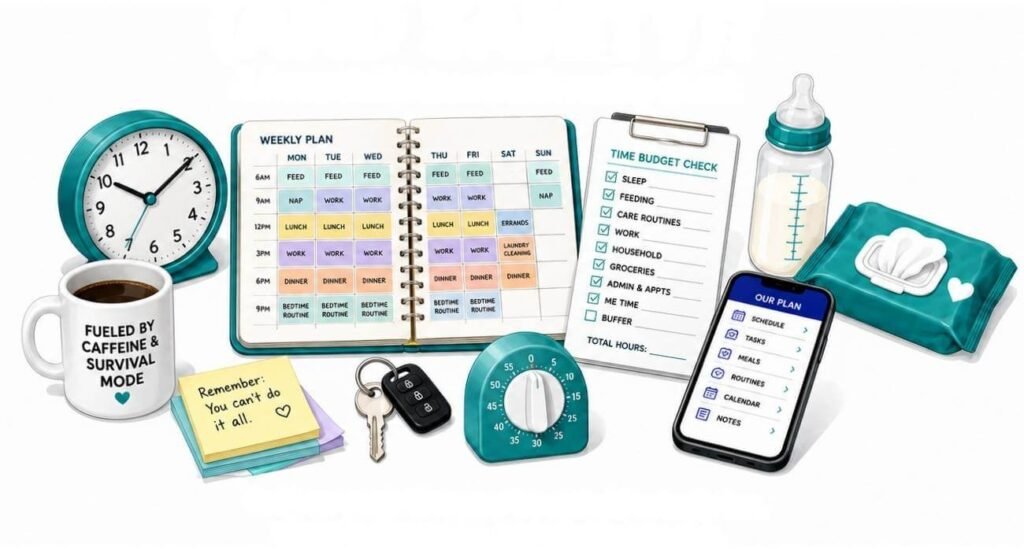
Will Your Baby Eat All Your Time
(and Sanity)?
See where the 168 hours in a week actually go once baby arrives.
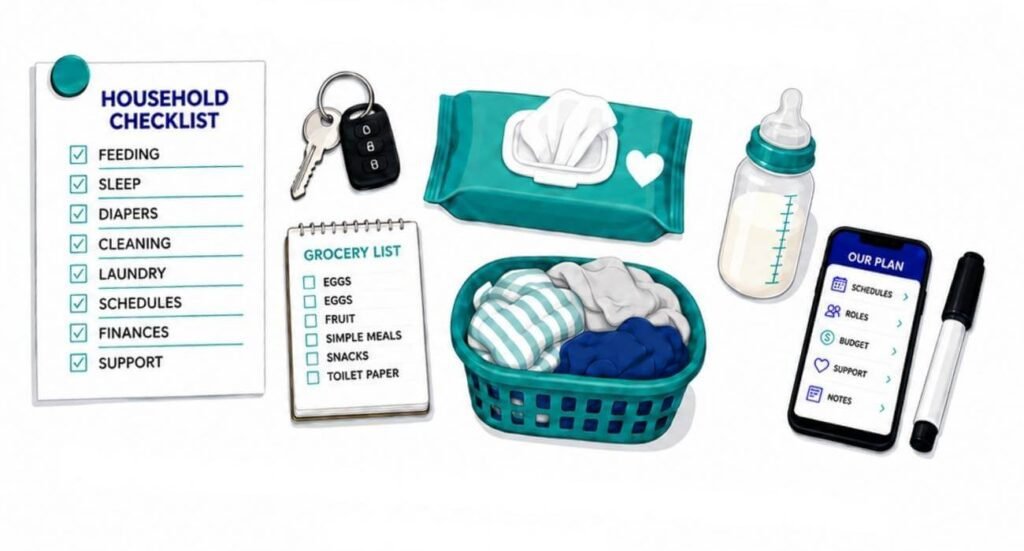
Will Your House Survive the Baby?
Spot what’s ready, what’s still in someone’s head, and where your home may need a clearer plan.
Both quizzes are free, take just a few minutes, and include practical takeaways. There may also be a little something waiting for you at the end.
Instead of asking…

How do we stay on top of everything?

How do we organize all of this?

Why does getting help take so much explaining?
Make the decisions once.
Stop carrying them every day.
A useful household system takes everyday information, routines and repeated decisions and turns them into defaults that are easier to see, share and use.
The goal isn’t to automate your life. It’s to stop spending energy solving the same ordinary problem over and over again.
The guide helps you ask…
What shouldn’t require anyone to remember?

Where does this keep getting stuck?
Could someone else step in and know where to start?
The work doesn’t disappear.
The repeated thinking can.
Laundry still needs doing. Dinner still needs making. Babies still wake up.
The goal isn’t to divide every household task perfectly or turn one person into the manager of everyone else. It’s to make information, routines and everyday decisions visible enough that the people involved can work from the same plan.
When everyone knows where to look, what the defaults are and what matters next, support becomes easier to share, delegate and hand over.

See the household. Build what matters.
Keep it moving.
The guide walks you through a practical process for finding the pressure points, building systems around real life and keeping them simple enough to actually use.
See what’s happening
Look at where information lives, which decisions keep coming back and where everyday tasks get stuck.
Household Audit • Standards • Pressure Points
Build what will help
Choose what matters, decide what “done” looks like and put simple structures in place that fit the household you actually have.
Command Centre • Landing Zone • Roster • Shared Information
Keep it moving
Use quick checks, shared routines and simple resets so the system keeps working when life shifts.
Weekly Meeting • Safe Word • 48-Hour Test • Simple Resets
You don’t need to overhaul the entire household in a weekend. Start with the place creating the most friction, build something people will actually use and add from there.
See the household. Build what matters.
Keep it moving.
The guide walks you through a practical process for finding the pressure points, building systems around real life and keeping them simple enough to actually use.
See what’s happening
Look at where information lives, which decisions keep coming back and where everyday tasks get stuck.
Household Audit • Standards • Pressure Points
Build what will help
Choose what matters, decide what “done” looks like and put simple structures in place that fit the household you actually have.
Command Centre • Landing Zone • Roster • Shared Information
Keep it moving
Use quick checks, shared routines and simple resets so the system keeps working when life shifts.
Weekly Meeting • Safe Word • 48-Hour Test • Simple Resets
You don’t need to overhaul the entire household in a weekend. Start with the place creating the most friction, build something people will actually use and add from there.
What changes when the household has a system?
The work becomes easier to see, share and pick up. People spend less time searching, deciding and explaining, and more time getting on with what needs to happen.
Before
After
Important information is scattered across phones, papers, cupboards and people’s memories.
People know where to look for the information they need.
The same ordinary decisions have to be made again and again.
Useful defaults handle more of the predictable stuff.
Sharing the work still requires a full briefing.
Someone can step in, find a starting point and actually help.
Tasks depend on someone noticing, remembering and following up.
Simple systems make the next step visible.
A busy week, sick day or rough night knocks everything off course.
Basic routines help the household recover without rebuilding from scratch.
Built for postpartum.
Useful long after it.
Postpartum changes how much time, energy and attention everyone has. The systems you build now can keep helping through daycare mornings, work weeks, sick days and everything else family life throws at you.
What changes when the household has a system?
The work becomes easier to see, share and pick up. People spend less time searching, deciding and explaining, and more time getting on with what needs to happen.
Before
Important information is scattered across phones, papers, cupboards and people’s memories.
After
People know where to look for the information they need.
Before
The same ordinary decisions have to be made again and again.
After
Useful defaults handle more of the predictable stuff.
Before
Sharing the work still requires a full briefing.
After
Someone can step in, find a starting point and actually help.
Before
Tasks depend on someone noticing, remembering and following up.
After
Simple systems make the next step visible.
Before
A busy week, sick day or rough night knocks everything off course.
After
Basic routines help the household recover without rebuilding from scratch.
Built for postpartum.
Useful long after it.
Postpartum changes how much time, energy and attention everyone has. The systems you build now can keep helping through daycare mornings, work weeks, sick days and everything else family life throws at you.
Choose the format that works for you.
Same practical approach. Two ways to use it.
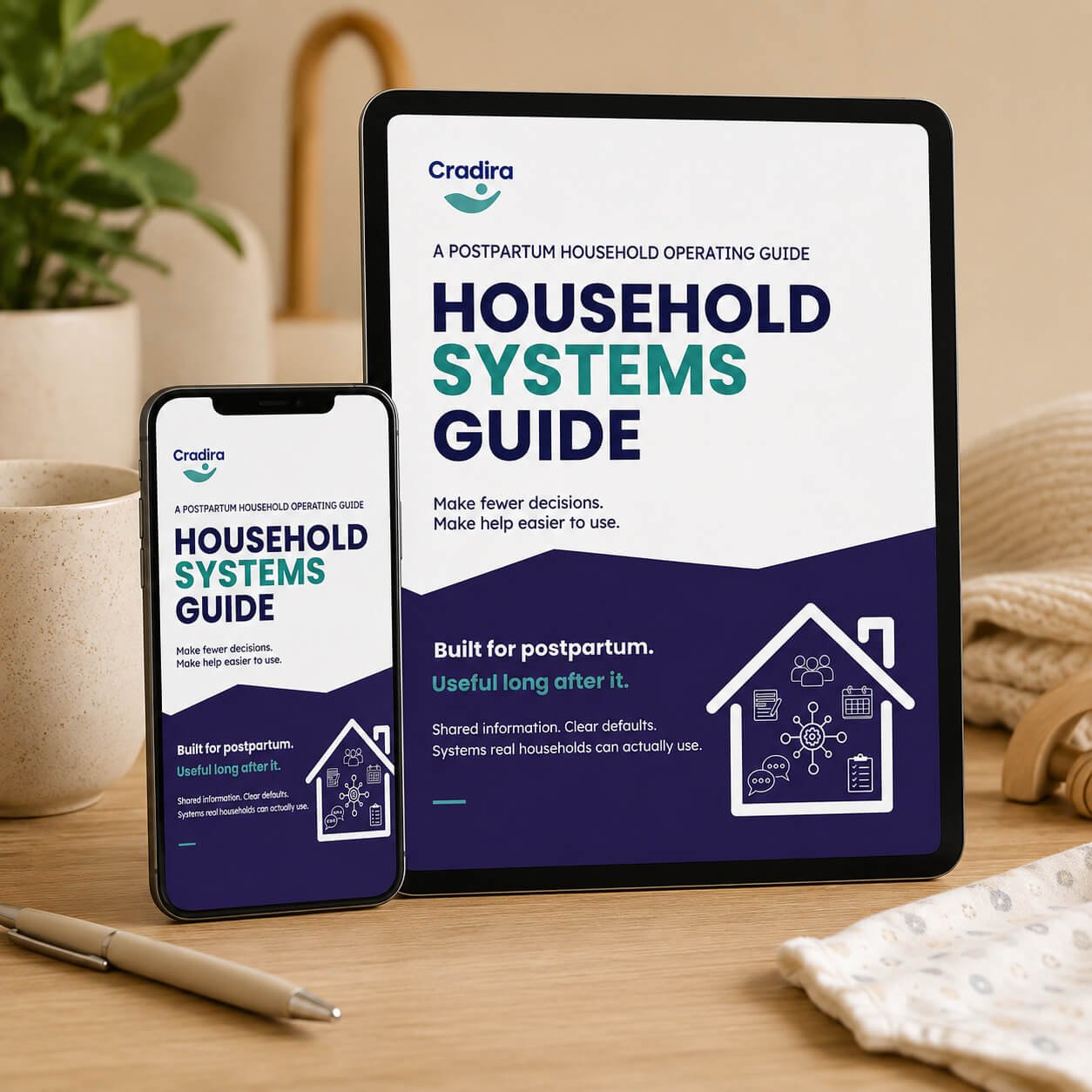
Digital Guide
Download the complete PDF immediately. Read it on screen or print it for personal use.
Includes 5 downloads of the PDF. Save a copy to your device and read it whenever you need it.
$19.97 CAD
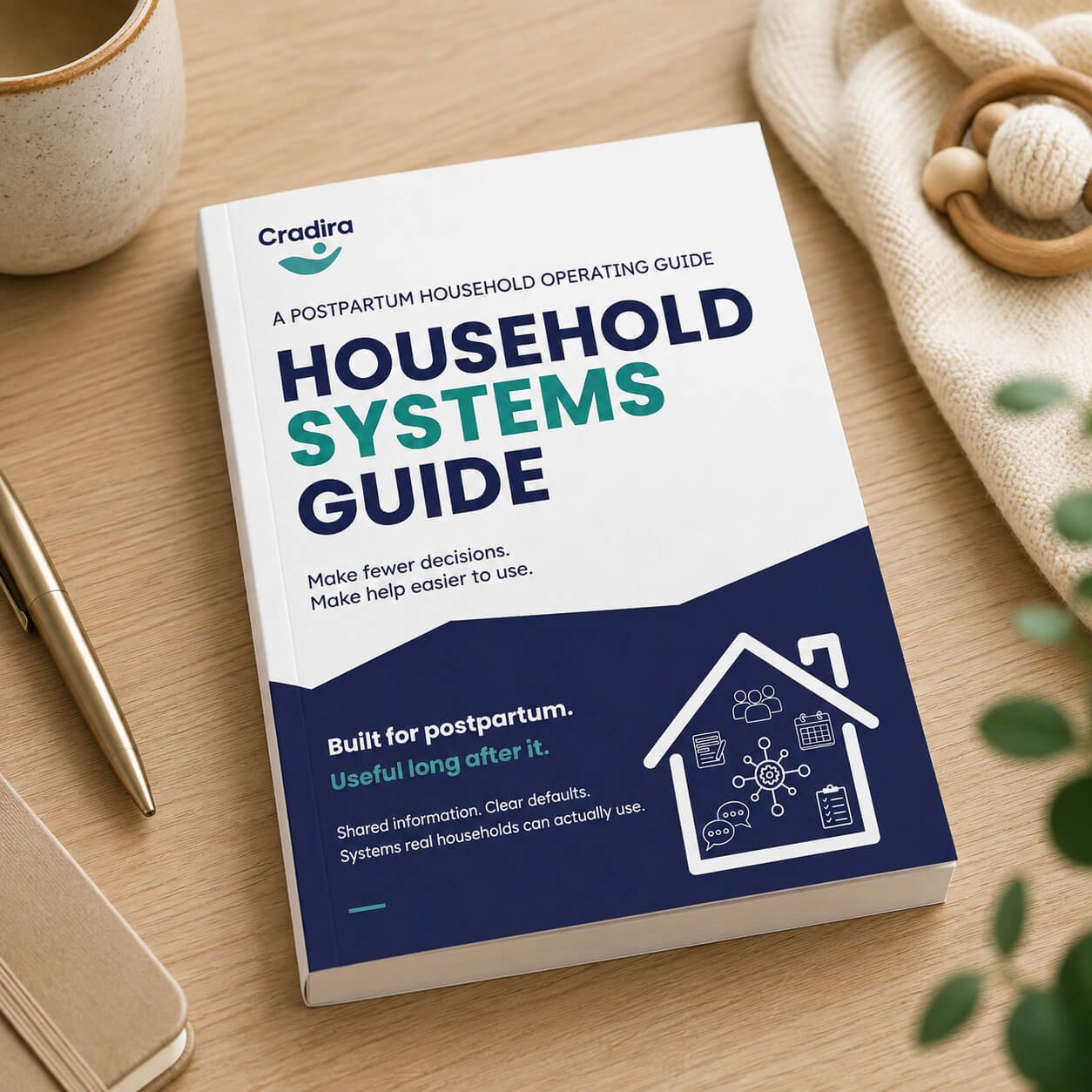
Paperback
A physical copy for anyone who prefers reading on paper and keeping the guide somewhere easy to reach.
$29.97 CAD
Take a look inside
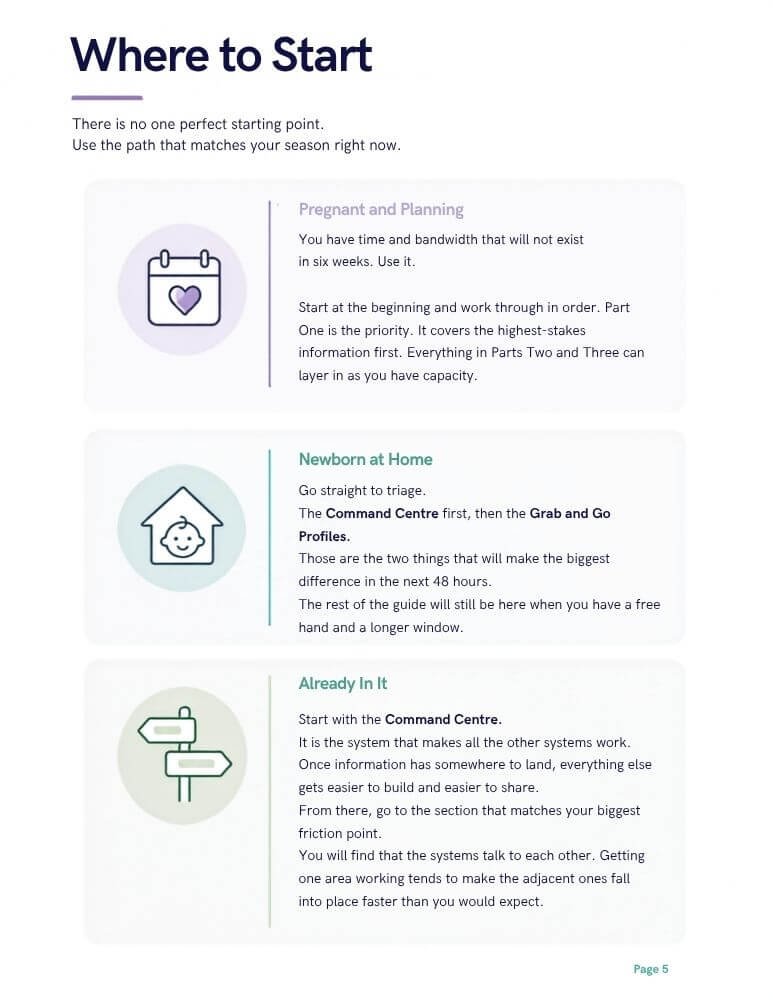
Choose a starting point based on your household’s current stage.
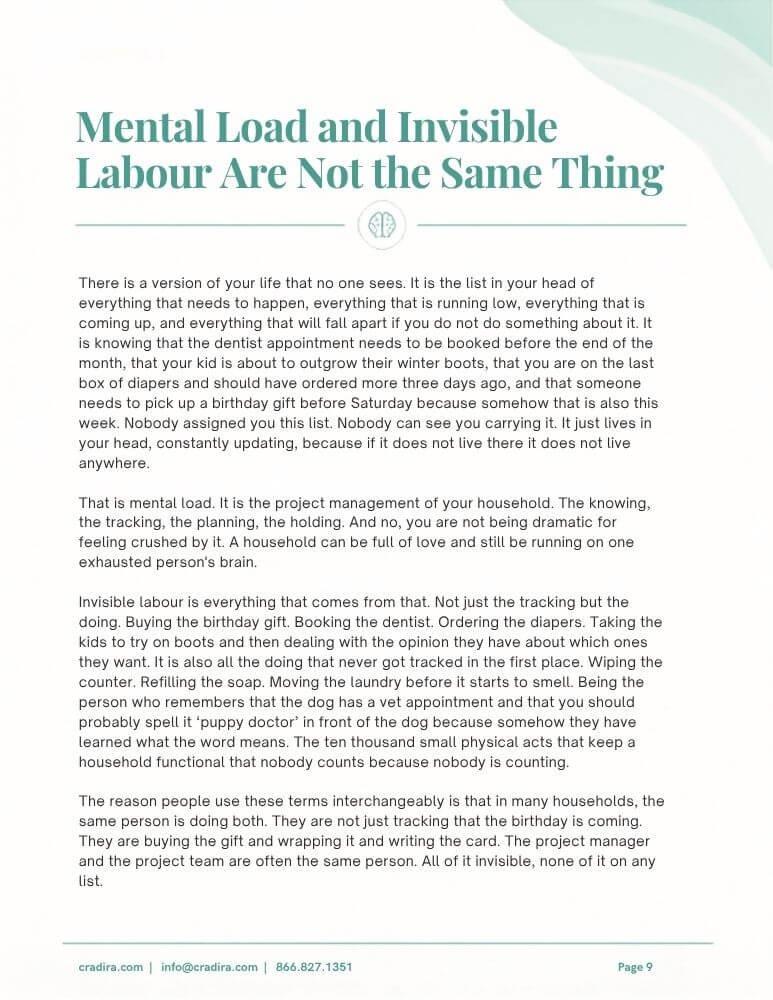
Understand the difference between doing the work and keeping track of it.
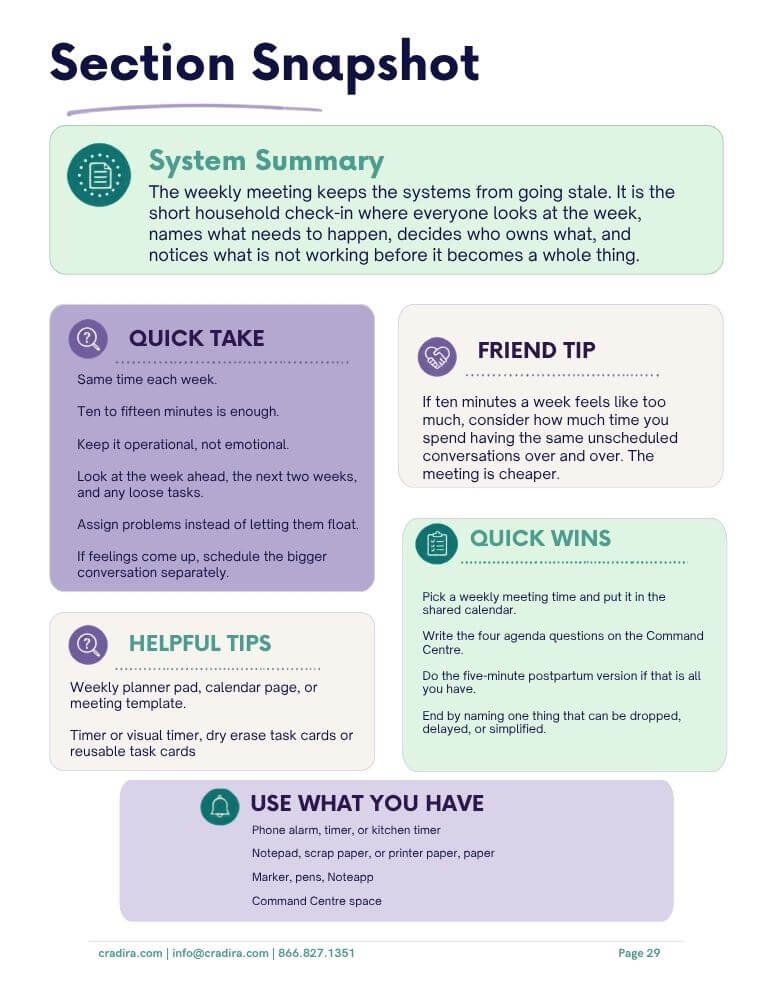
Choose a starting point based on your household’s current stage.
The guide combines deeper explanations, practical systems, quick wins and clear starting points so you can use the parts that make sense for your household.
Please don’t turn this into another project.
You don’t need to implement every system in this guide.
Start with the place where your household is creating the most friction. Meals. Laundry. Shared information. Visitors. Mornings. Whatever keeps requiring more thought than it deserves.
Build something that helps. Leave the rest until you need it.
This might be where you start if…
Want help putting it into practice?
Systems Setup Session
Work through your actual household and build the systems around your routines, people and pressure points.
More Support Options
Virtual and in-home support for the parts of family life that need more than a guide.
Quick answers
Is the Household Systems Guide only for new parents?
No. It was created with pregnancy and postpartum in mind, but the systems are designed to work across everyday family life.
Do we need to complete the whole guide?
No. Start where the friction is. You may use five systems, fifteen systems or one system that solves a very annoying problem.
Is this a planner or workbook?
No. It is a self-directed informational guide with explanations, examples, checklists and practical ideas. There are no workbook pages to complete.
Are templates included?
No. Templates and app access are not included with the guide. They are separate Cradira resources.
Do I need to buy special products?
Not necessarily. Many systems can use what you already have. Others may be easier with basics such as a binder, whiteboard, labels or baskets. You choose what works for your space and budget.
How many times can I download the digital guide?
Your purchase includes 5 downloads of the PDF through your purchase link. Save a copy to your device so you can open and read it as often as you like without downloading it again. If you reach the limit and need help accessing your copy, email info@cradira.com with your order number.
What format does the guide come in?
The Household Systems Guide is available in two formats. You can purchase the digital PDF version directly through the Cradira website for immediate access, or choose the paperback version through Amazon if you prefer a physical copy to read and keep on hand.
Can Cradira help me put the systems into practice?
Yes. A Systems Setup Session helps you apply the guide to your household, identify pressure points and build systems around your routines, people and available support. Contact us to arrange a session. Virtual postpartum support and in-home postpartum support are also available if you need broader help. Personalized support is booked separately from the guide.

You don’t need a perfect household.
You need systems people can actually use.
Choose the self-directed guide, or explore virtual support if you want personalized help building a plan for your household.