

Why Postpartum Feels So Overwhelming (And What Actually Helps)
If you’re wide awake at 3 a.m. wondering if you’re failing, you’re not. Here’s why postpartum feels so overwhelming and what actually helps.
Last updated October 2026
The short answer
- Why postpartum feels so overwhelming comes down to several big changes arriving at once: hormonal shifts, sleep deprivation, feeding pressure, an identity shift and unrealistic “super parent” expectations.
- It happens to birthing, non-birthing, adoptive and surrogacy parents. The sources differ, but the overwhelm is just as real.
- It is not a sign you’re failing. It is a normal response to one of the most intense transitions humans go through.
- What helps is matching the type of support to the cause: overnight support for sleep, daytime support for hands-on help, virtual support for guidance and planning, and community for connection.
- The best time to plan is before the baby arrives, or as soon as possible after placement.
If you’re reading this at 3 a.m. while your baby finally sleeps and you’re wide awake wondering if you’re losing your mind, you’re not alone. And no, you’re not failing at parenting. You’re experiencing one of the most biologically and emotionally intense transitions humans go through, and almost nobody prepares you for how overwhelming it actually feels.
As Perinatal Support Workers with over 35 years of combined experience supporting families across Toronto and the GTA, we’ve seen this pattern hundreds of times. Parents who were competent, confident, capable adults suddenly feel like they’re drowning in a sea of conflicting advice, impossible expectations, and their own exhaustion.
So let’s talk honestly about why postpartum feels so overwhelming for every kind of family, and more importantly, what actually helps.
How do hormone changes affect every kind of new parent?

Here’s the thing nobody tells you: becoming a parent changes your body and brain chemistry whether you gave birth or not. The changes look different depending on your path to parenthood, but they’re real and they’re intense.
For birthing parents: the hormonal crash nobody warns you about
If you gave birth, your body just went through something extraordinary. Estrogen increases 100 to 1,000 times during pregnancy and drops dramatically within hours after birth. Progesterone, which was keeping you pregnant and relatively calm, also plummets. These aren’t small shifts. These are massive, rapid hormonal changes that your brain and body have to adjust to while you’re also trying to keep a tiny human alive.
The first 72 hours see the sharpest drop, which is why the “baby blues” hit so many people around day three. You might find yourself crying over absolutely nothing, feeling anxious for no clear reason, or experiencing mood swings that make you feel like a stranger in your own body.
Most people’s hormones start to stabilize around six weeks postpartum, but “stabilize” doesn’t mean “back to normal.” It means your body is finding a new baseline, and that process can take months, especially if you’re chestfeeding.
These hormonal changes can also cause perimenopausal-like symptoms such as night sweats, which further disrupt your already fragile sleep. And when sleep is disrupted, everything else gets harder.
For non-birthing parents (including same-sex partners): the hormonal shift you didn’t know was happening
Here’s what most people don’t realize: if you’re a non-birthing parent who was closely involved during pregnancy or early care-giving, your hormones have been changing too. This includes non-birthing parents in same-sex couples, where hormonal shifts are driven not by pregnancy, but by proximity, bonding, and care-giving demands.
Research shows that testosterone can drop significantly in many non-birthing parents who are closely involved during pregnancy and early care-giving, including a documented 34% drop in expectant fathers starting during pregnancy and continuing postpartum. Prolactin (yes, the same hormone involved in milk production) increases. Oxytocin rises with baby contact. And these shifts aren’t random. They’re your body preparing you for care-giving, making you more alert to your baby’s needs, more patient, more bonded.
But here’s the catch: lower testosterone can mean lower energy, lower motivation, changes in mood, and sometimes feelings of being overwhelmed or irritable. You might not have the physical recovery of birth, but your body is absolutely going through something real.
And if you’re feeling disconnected or struggling, it’s not because you’re not bonding properly. It’s partly biology working itself out.
For adoptive and surrogacy parents: different path, same overwhelm
If you became a parent through adoption or surrogacy, you didn’t have the pregnancy-proximity hormonal preparation. Your body didn’t get the slow biological prep time. This is especially true for same-sex couples, where neither parent may have experienced pregnancy-related hormonal preparation, yet both are navigating the full emotional, cognitive, and physical demands of early care-giving at once.
But here’s the good news: oxytocin, the bonding hormone, increases with touch. The more you hold, feed, change, soothe, and engage with your baby, the more your brain chemistry shifts to support that bond. It’s not instant like pregnancy hormones, but it happens.
And everything else? The exhaustion, the learning curve, the feeding challenges, the identity shift, the isolation? All of that hits just as hard. Your overwhelm is just as valid. The sources might be different, but the experience is just as real.
Is sleep deprivation more than just being tired?

Here’s the thing nobody tells you: becoming a parent changes your body and brain chemistry whether you gave birth or not. The changes look different depending on your path to parenthood, but they’re real and they’re intense.
For birthing parents: the hormonal crash nobody warns you about
If you gave birth, your body just went through something extraordinary. Estrogen increases 100 to 1,000 times during pregnancy and drops dramatically within hours after birth. Progesterone, which was keeping you pregnant and relatively calm, also plummets. These aren’t small shifts. These are massive, rapid hormonal changes that your brain and body have to adjust to while you’re also trying to keep a tiny human alive.
The first 72 hours see the sharpest drop, which is why the “baby blues” hit so many people around day three. You might find yourself crying over absolutely nothing, feeling anxious for no clear reason, or experiencing mood swings that make you feel like a stranger in your own body.
Most people’s hormones start to stabilize around six weeks postpartum, but “stabilize” doesn’t mean “back to normal.” It means your body is finding a new baseline, and that process can take months, especially if you’re chestfeeding.
These hormonal changes can also cause perimenopausal-like symptoms such as night sweats, which further disrupt your already fragile sleep. And when sleep is disrupted, everything else gets harder.
For non-birthing parents (including same-sex partners): the hormonal shift you didn’t know was happening
Here’s what most people don’t realize: if you’re a non-birthing parent who was closely involved during pregnancy or early care-giving, your hormones have been changing too. This includes non-birthing parents in same-sex couples, where hormonal shifts are driven not by pregnancy, but by proximity, bonding, and care-giving demands.
Research shows that testosterone can drop significantly in many non-birthing parents who are closely involved during pregnancy and early care-giving, including a documented 34% drop in expectant fathers starting during pregnancy and continuing postpartum. Prolactin (yes, the same hormone involved in milk production) increases. Oxytocin rises with baby contact. And these shifts aren’t random. They’re your body preparing you for care-giving, making you more alert to your baby’s needs, more patient, more bonded.
But here’s the catch: lower testosterone can mean lower energy, lower motivation, changes in mood, and sometimes feelings of being overwhelmed or irritable. You might not have the physical recovery of birth, but your body is absolutely going through something real.
And if you’re feeling disconnected or struggling, it’s not because you’re not bonding properly. It’s partly biology working itself out.
For adoptive and surrogacy parents: different path, same overwhelm
If you became a parent through adoption or surrogacy, you didn’t have the pregnancy-proximity hormonal preparation. Your body didn’t get the slow biological prep time. This is especially true for same-sex couples, where neither parent may have experienced pregnancy-related hormonal preparation, yet both are navigating the full emotional, cognitive, and physical demands of early care-giving at once.
But here’s the good news: oxytocin, the bonding hormone, increases with touch. The more you hold, feed, change, soothe, and engage with your baby, the more your brain chemistry shifts to support that bond. It’s not instant like pregnancy hormones, but it happens.
And everything else? The exhaustion, the learning curve, the feeding challenges, the identity shift, the isolation? All of that hits just as hard. Your overwhelm is just as valid. The sources might be different, but the experience is just as real.
Is sleep deprivation more than just being tired?
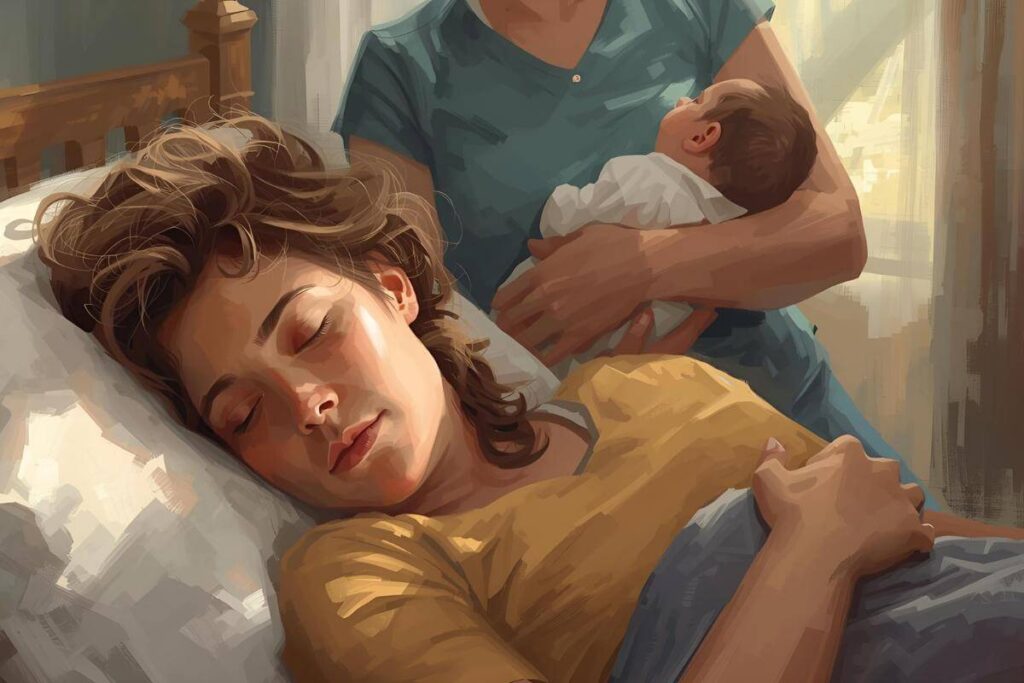
Let’s be blunt about this, because it matters. Research shows that after 17-19 hours without sleep, performance impairment equals a blood alcohol content of 0.05%, and after 24 hours awake, impairment reaches 0.10%, which is beyond the legal limit for driving in most places.
You’re not imagining it. Sleep deprivation literally impairs your ability to think, process information, coordinate movements, regulate emotions, and make decisions. Your reaction times slow by up to 50%. Your memory becomes unreliable. Your perception of time warps. That baby who’s been crying for five minutes feels like they’ve been crying for an hour, which makes you feel like they’re always crying and never sleeping.
This isn’t weakness. This is neuroscience.
And here’s the cruel part: sleep deprivation also affects your judgment, which means you might not realize how impaired you actually are. Just like someone who’s had too much to drink might insist they’re fine to drive, sleep-deprived parents often push themselves far past the point where they can function safely.
This affects every parent the same way. Birthing, non-birthing, adoptive, foster, doesn’t matter. When you’re running on fumes, your brain stops working properly, and everything feels exponentially harder.
How do feeding challenges add to the overwhelm?
Whether you’re chestfeeding, pumping, formula feeding, or doing some combination of all three, feeding challenges can add enormous stress to an already overwhelming situation.
For many people, especially those who identify as women or who carried the pregnancy, the ability to feed becomes tied to identity and sense of success or failure as a parent. “My body was built to do this, so if I can’t, my body is failing me.” This feeling is even more intense for people who struggled to conceive, underwent fertility treatments, or experienced pregnancy loss.
For non-birthing parents, there can be pressure around “what you can contribute” since you’re not the one feeding. Or guilt about not being able to help with that specific task. Or frustration when you try to bottle-feed and the baby refuses.
For adoptive parents or those using surrogacy, feeding might feel like one of the first real parenting tasks you’re responsible for, and when it’s not going smoothly, it can feel like you’re already failing.
The societal pressure doesn’t help. The message is everywhere: to be a good parent, you need to do it “this way.” And if you can’t, you’ve somehow failed. Except that’s complete nonsense.
Fed is best. Your baby needs to eat and you need to feel supported in however that happens, not judged.
Why does the myth of the super parent make it worse?
Here’s one of the biggest problems: the societal expectation that parents should be able to do everything. Keep the house running, have a perfect baby who sleeps through the night by two weeks, maintain a perfect relationship, look put-together, bounce back physically (if you gave birth), go back to work quickly, and do it all without help or complaining.
That’s not realistic. It’s not even human.
Yet when you struggle, when the house is a mess, when the baby cries more than you expected, when you’re too exhausted to shower, the narrative in your head is often “everyone else can handle this, so why can’t I?”
The truth? Most people can’t handle it alone. They’re just not talking about it publicly. And the ones who seem to have it all together? They usually have way more support than they’re letting on.
Why does the identity shift hit so hard?
You were someone before this baby. You had routines, competence, structure, answers. You knew who you were.
Now? Everything has changed overnight.
This identity shift hits some people harder than others. We’ve worked with engineers, lawyers, executives, and other high-achieving professionals who were used to being in control, having answers, and knowing what to do. Suddenly they’re thrown into a situation where nothing is in their control, there are no clear answers, and the baby didn’t read any of the parenting books.
For some parents, this is thrilling. They love the newborn phase and thrive in the chaos. For others, it’s destabilizing in a way they didn’t expect. Both responses are normal.
And this happens to every kind of parent. Birthing, non-birthing, first-time, experienced, adoptive, biological, doesn’t matter. Your entire life just changed, and you’re trying to figure out who you are now while keeping a tiny human alive.
What are the signs you’re reaching your limit?
Here are some patterns we see when parents are hitting their breaking point:
- You’re not sleeping even when you have the chance. Your mind won’t shut off.
- You’re not eating well or taking care of basic needs like showering.
- You’re highly anxious and responding to every single baby noise.
- You’re assigning emotions and preferences to your baby that may not actually exist. “They hate the swing. They only want to be held. They don’t like the car seat.” Some of this might be true, but exhausted parents often take it to extremes.
- You’re feeding super frequently, beyond what’s developmentally necessary, because you’re worried or because it’s the only thing that seems to work.
- You feel like you’re failing constantly.
If any of this sounds familiar, you’re not broken. You’re overwhelmed, and you need more support than you’re currently getting.
If your emotions feel unmanageable or frightening, tell your care provider. If you are in crisis or having thoughts of harming yourself or your baby, call or text 988 (Canada’s Suicide Crisis Helpline) at any time, or go to your nearest emergency department. Postpartum Support International also has resources and a helpline (1-800-944-4773) available to all parents.
What actually helps? The types of support that reduce overwhelm
The good news? Support exists. And different types of support help in different ways depending on what’s causing your overwhelm.
- Overnight support helps when sleep deprivation is your biggest challenge. Having someone handle the night shift so you can sleep for a solid stretch makes an enormous difference in your ability to cope during the day. Some families book a few nights a week. Others need more intensive coverage. It depends on your situation, your mental health history, your recovery (if you gave birth), and what other support you have.
- Daytime support helps when you need hands-on guidance, help with routines, someone to hold the baby while you rest or shower, and practical help with things like baby laundry and bottle washing. It’s especially valuable for parents without nearby family or friends who can pitch in regularly.
- Virtual support works well for parents who don’t need someone physically in their home but do need expert guidance, troubleshooting help, and a plan they can follow. It’s also great for planning ahead before the baby arrives, and the “Now What” Call is built for one specific “we need to talk this through” moment.
- Community-based support like parent groups, prenatal class connections, or local networks can provide emotional support and the reminder that you’re not alone in this.
The key is matching the type of support to what you actually need, not what you think you “should” need.
How can partners, family and friends help without adding stress?
Here’s what actually helps from the people around you:
- Don’t talk in extremes. “You look amazing!” when someone feels like a disaster, or “This is the hardest thing ever” when they’re trying to stay positive, both miss the mark.
- Don’t make it about you. “I remember when I had a newborn…” is rarely helpful unless explicitly asked for.
- Anticipate needs instead of waiting to be told. Bring food. Do a load of laundry. Take the baby for an hour so the parent can nap.
- Reduce the mental load. Don’t ask “what can I do?” Ask “can I bring dinner on Thursday?” or “can I take your toddler to the park Saturday morning?”
- And please, for the love of all that is holy, don’t show up unannounced expecting to be entertained while the parent handles everything.
What can you put in place early to lighten the load?
The best time to plan for postpartum support is before the baby arrives (or as soon as possible after placement, for adoptive families). Here’s what we strongly recommend:
If you want help doing this, the free Time Quiz and House Quiz show where your hours and household systems are likely to strain, and the Household Systems Guide walks through setting them up.
Look at your home and life pre-baby. What gets done daily, weekly, monthly to keep things functioning? Who does those things? When one or both parents are directly caring for a baby 8-12 hours a day (or more), who’s going to fill the gap?
Make a realistic plan. Do you need to hire help? A house cleaner once a week? Someone to mow the lawn or shovel snow? Do you need to create easy systems like buying pre-cut fruit instead of whole fruit, or cooking freezer meals ahead of time?
Keep older kids’ routines as stable as possible. Don’t pull them out of daycare to “save money.” That’s their routine, their social outlet, and your break.
Exchange childcare with a friend. A few hours a week where they watch your baby so you can handle tasks or nap, and you do the same for them on their day.
And seriously, do not get a pet right before or right after having a baby. Just don’t.
Where do we support families?
We work across Toronto and the GTA, including North York, Etobicoke, Scarborough, Vaughan, Woodbridge, Bolton, Brampton, Mississauga, Oakville, Milton, Stoney Creek, and Hamilton.
Virtual support is available across Canada and beyond. See our local pages for Toronto, Brampton, and Hamilton and Stoney Creek.
You’re not supposed to do this alone
The biggest lie of modern parenting is that you should be able to handle it all by yourself. You’re not supposed to. Humans evolved to raise children in communities with extended support networks. The isolation many parents feel today is not natural, and it’s not sustainable.
If you’re overwhelmed, exhausted, anxious, or barely holding it together, that’s not a sign you’re failing. It’s a sign you need more support.
You can reach us through our contact page to talk about what support might look like for your family. Whether it’s overnight care, daytime help, virtual guidance, or a combination, we can help you figure out what would actually make life feel manageable again.
You can also explore Cradira Support for in-home care, or Cradira Digital for the free quizzes, the Household Systems Guide and virtual support.
Keep reading: postpartum loneliness, postpartum burnout, and how to survive the first six weeks with a newborn.
You don’t have to white-knuckle your way through this. You deserve to feel supported, rested, and confident, not drowning.
Frequently asked questions
Why does postpartum feel so overwhelming?
Because many large changes hit at once: rapid hormonal shifts, sleep deprivation that impairs thinking and decision-making, feeding pressure, an identity shift and unrealistic expectations. It happens to birthing, non-birthing, adoptive and surrogacy parents.
Do non-birthing parents have hormonal changes too?
Research shows that testosterone can drop significantly in many non-birthing parents who are closely involved during pregnancy and early care-giving, while prolactin and oxytocin rise. These shifts can affect energy and mood.
Is sleep deprivation really that serious?
Yes. Research shows that after 17 to 19 hours without sleep, performance impairment is comparable to a blood alcohol level of 0.05%, and after 24 hours awake it reaches 0.10%. It affects thinking, emotional regulation and decisions.
What kind of support helps most with postpartum overwhelm?
It depends on the cause: overnight support for sleep deprivation, daytime support for hands-on help and routines, virtual support for guidance and planning, and community support for connection.
When should you get help for postpartum overwhelm?
Sooner than you think. If you can’t sleep when you have the chance, aren’t eating or showering, feel highly anxious or feel like you’re failing constantly, you need more support than you’re currently getting.






2 Comments
Comments are closed.