

Newborn Sleep Explained: What Parents Actually Need to Know
Why your newborn wakes so often, what’s actually normal, and gentle ways to support sleep without sleep training.
Last updated October 2026
The short answer
- Newborn sleep is different from older baby sleep and adult sleep. Most newborns need about 14 to 17 hours in 24 hours, in short chunks around the clock.
- They wake every two to three hours because of small stomachs, new nervous systems and short 45 to 60 minute sleep cycles.
- Much of the grunting and squeaking is active sleep, not waking. Pausing before you go in can help.
- In the early weeks, wake windows are only about 45 to 55 minutes, including feeding.
- Sleep training isn’t appropriate for newborns. Sleep nurturing is: a safe sleep space, respected wake windows and gentle patterns.
- Follow Canadian Paediatric Society safe sleep guidance: alone, on their back, in a crib or other approved safe sleep space.
You’re three weeks in. Your baby has been asleep for forty-five minutes. You’ve managed to shower, eat something that vaguely resembles food, and sit down for the first time since 6 a.m.
And then you hear it.
That little grunt. The squeak. The movement through the monitor.
Your entire body tenses. Is the baby waking up? Should you go in? Should you wait? If you wait too long, will they start screaming? If you go in too soon, will you wake them up when they were actually still asleep?
You have no idea what to do. And you’re so tired you can barely think.
Here’s the thing nobody tells you: newborn sleep is confusing because it’s fundamentally different from older baby sleep, and definitely different from adult sleep. The “rules” don’t apply yet. The strategies people swear by don’t work. And half the time, you’re responding to a baby who’s technically still asleep.
So let’s talk about what’s actually happening when your newborn sleeps, and what you can realistically do about it without losing your mind.
How Much Sleep Do Newborns Actually Need?
Most newborns need 14 to 17 hours of sleep in a 24-hour period, though this varies. Some need a bit more. Some need a bit less. Your baby is not broken if they don’t hit exactly 16 hours.
The challenge isn’t the total amount of sleep. It’s that this sleep is broken into short chunks around the clock. Your newborn doesn’t know the difference between day and night yet. They just know when they’re tired, when they’re hungry, and when they need comfort.
In the early weeks, you might get stretches of two to three hours between wake-ups if you’re lucky. Sometimes less. Occasionally more. But expecting a newborn to sleep in long, predictable stretches is like expecting them to walk at two weeks old. Their bodies just can’t do it yet.
Why do newborns wake every 2 to 3 hours?
Your baby wakes constantly because of three main things, and none of them are your fault.
First, they have tiny stomachs that empty fast. Newborns have stomachs roughly the size of a walnut. Breast milk digests in about two hours. Formula takes a bit longer but not much. When your baby wakes every two to three hours to eat, that’s not a sleep problem. That’s biology. And that 2-3 hours is counted from the beginning of one feed to the beginning of the next, just like timing contractions.
Second, they have brand new nervous systems that are still figuring everything out. Your baby spent nine months in a warm, dark, constantly moving environment where every need was met automatically. Now they’re out here in the world with lights, sounds, temperature changes, and the need to actually signal when something’s wrong. Their nervous system is adjusting. It takes time.
Third, and this is the big one that nobody explains well, they have really short sleep cycles.
What does a newborn sleep cycle look like?
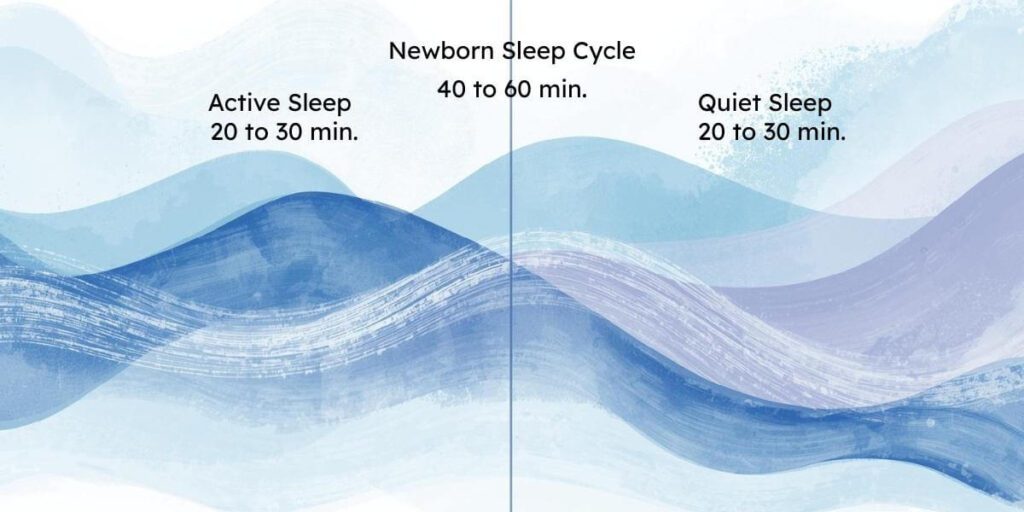
Adults cycle through sleep stages roughly every 90 minutes. Newborns? Every 45 to 60 minutes.
Within each cycle, your baby experiences both active sleep and quiet sleep. Each phase lasts about 25 minutes within that 45-60 minute cycle.
Active sleep is when your baby grunts, squeaks, twitches, and moves. Their eyes move under their eyelids. Their breathing might be irregular. They make all kinds of weird noises. Parents often think their baby is awake during active sleep because of all the movement and sound. They’re not. They’re deeply asleep. This is normal. Don’t rush in.
Quiet sleep is what it sounds like. Your baby is still. Their breathing is regular. They’re not making noise. This is the sleep that looks like what adults think sleep should look like.
Here’s the part that makes newborn sleep so hard: at the end of each 45-60 minute cycle, your baby briefly rouses. They might squeak. Move. Grunt. Open their eyes for a second. And then, if everything is okay, they drift back into the next cycle.
But here’s where it gets tricky. If you rush in the moment you hear noise, you might fully wake a baby who would have settled back down on their own. If you don’t respond when they actually need you, they’ll escalate to crying. And you’re too tired to tell the difference.
This is not a sign that you’re doing it wrong. This is just what newborn sleep is like.
How long can a newborn stay awake? Understanding wake windows
Here’s something that surprises most parents: in the early weeks, your newborn should only be awake for 45 to 55 minutes between sleep periods. That includes feeding time.
So if your baby wakes at 3 p.m. and takes 30 minutes to feed, they should be back asleep by 4 p.m. at the latest.
By four months, wake windows stretch to about two hours. But in the newborn phase, babies get overtired fast. And overtired babies don’t sleep better. They sleep worse. They fight sleep. They wake more often. They’re harder to soothe.
If your baby is melting down every evening, there’s a good chance they’ve been awake too long during the day, and by night they’re running on fumes.
How do you create a safe sleep environment from day one?
Before we talk about helping your baby sleep, let’s talk about safe sleep. Because this is non-negotiable.
Follow the Canadian Paediatric Society safe sleep guidelines and the American Academy of Pediatrics recommendations. Both organizations provide detailed, evidence-based guidance on creating a safe sleep space.
The ABCs of safe sleep: Alone, on their Back, in a Crib or other approved safe sleep space.
Alone means no bed-sharing. No sleeping on couches or chairs with your baby on your chest. No blankets, pillows, stuffed animals, or crib bumpers in the sleep space. Just a firm, flat mattress with a fitted sheet.
Back means always placing your baby on their back to sleep until they can roll both ways on their own, which typically happens around four to six months, though some babies do it earlier. Once your baby can roll both ways independently, you don’t need to keep flipping them back over all night. But until then, back is safest.
Crib means a crib, bassinet, or pack-and-play with a firm, flat mattress and a fitted sheet. That’s it. Nothing else.

What actually helps newborns sleep (within safe sleep guidelines)
Make the room dark. Blackout curtains or blinds help signal that it’s sleep time. Light tells your baby’s brain to wake up. Darkness supports sleep.
Add white noise. Constant, gentle sound can help your baby stay asleep through minor disruptions and can soothe a fussy baby. Keep it at a safe, moderate volume and position it away from the crib, ideally between your baby and other sources of noise you’re trying to block. White noise machines at safe volumes can be helpful, but don’t place them right next to your baby’s head.
Consider swaddling. If your baby isn’t showing any signs of rolling yet, typically before four to six months, a safe swaddle can help prevent the startle reflex from waking them up. Once they show signs of rolling, stop swaddling immediately.
Keep the room at a comfortable temperature. Not too hot. Not too cold. Somewhere between 68 and 72°F (about 20 to 22°C) is usually right. Your baby should feel warm to the touch but not sweaty or cold.
These basics matter. They give your baby the best chance at stringing sleep cycles together without fully waking.
What should you expect in the first few months?
Here’s what’s realistic, broken down by weeks so you know you’re not losing your mind.
In weeks zero to two, you’re in pure survival mode. Your baby will wake every 2-3 hours around the clock to eat. Sometimes more often. This is normal. You’re not doing anything wrong.
From weeks two to six, you’re still waking every 2-3 hours, but you might start to see one slightly longer stretch at night, maybe three to four hours if you’re lucky. Maybe not. Both are normal.
Between weeks six and twelve, some babies start to stretch nighttime sleep to four to five-hour chunks. Some don’t. Some go backward. Sleep is rarely linear. Just when you think you’ve figured it out, everything changes.
By three to four months, many babies can handle longer stretches between night feeds. But this is also when the four-month sleep regression hits, and everything you thought you knew falls apart again. We’ll save that for another post.
The point is this: if your two-week-old isn’t sleeping through the night, that’s not a problem. That’s normal. If your eight-week-old still wakes every two hours, that’s hard, but it’s not a sign that you’re failing.
What’s the difference between sleep training and sleep nurturing?
Let’s be clear about something: sleep training is not appropriate for newborns.
Sleep training, meaning structured methods where you allow some level of crying to teach independent sleep, is generally not recommended until at least four to six months old, and even then, it’s a personal choice.
What you can do with a newborn is sleep nurturing. This means creating a safe sleep environment, respecting wake windows so your baby doesn’t get overtired, establishing some gentle patterns without rigid schedules, responding to your baby’s needs while also giving them a moment to settle before rushing in, and working with your baby’s biology instead of against it.
Sleep nurturing is not about making your baby sleep through the night at six weeks old. It’s about setting up conditions that support sleep as much as possible while your baby’s system matures.
How are feeding and sleep connected?
Feeding affects sleep, but it’s more nuanced than most advice makes it sound. Feeding works on a 24-hour cycle. It’s not about how much your baby eats per feeding, but how much total they eat over 24 hours.
If your baby doesn’t get sufficient food during the day, they will need to wake more frequently at night to make up those ounces. So while feeding well during the day doesn’t guarantee longer stretches at night, not feeding enough during the day will almost certainly contribute to more frequent nighttime wakes.
Some babies have feeding issues that affect sleep. Tongue ties, allergies, gas, reflux, or needing different bottles or nipple sizes can all make a baby uncomfortable and disrupt sleep. If your baby seems uncomfortable or in pain, talk to your pediatrician or a lactation consultant. Sometimes there’s something fixable. Sometimes there’s not. But it’s worth checking.
What gentle strategies actually help?

These aren’t magic. But they can help.
Count to ten
When you hear your baby making noise through the monitor, pause. Count to ten. Wait and watch. Give your baby a moment to see if they settle back down on their own.
This isn’t about letting your baby cry it out. It’s about waiting for things to escalate versus responding right away. It’s about giving them space to settle back down on their own if they’re still in active sleep and not actually awake.
If they’re escalating, if the noises are getting louder, more distressed, go to them. But if they’re just grunting and squeaking in that half-asleep newborn way, give them ten seconds. You might be surprised how often they drift back to sleep.
Establish some gentle daytime and nighttime differences
You don’t need a strict schedule. But you can start to create some patterns.
When your baby is awake during the day, keep lights on, interact and play, and let normal household activity happen. When they’re sleeping during the day, they still need a sleep-supportive environment: darkness, white noise, calm. Sleep is essential for their health and development, whether it’s day or night.
At night, keep all interactions quiet and minimal. Feed, change, put back down without much talking or eye contact. Use darkness and white noise consistently.
This isn’t about teaching your baby the difference between day and night: babies don’t produce melatonin on a circadian rhythm yet. It’s about giving them stimulation when they’re awake during the day, and prioritizing sleep-supportive environments for all sleep, day and night.
Watch wake windows
If your baby has been awake for 45-55 minutes, start working toward sleep. Don’t wait until they’re screaming. By then they’re overtired, and it’s harder.
Look for sleepy cues: yawning, rubbing eyes, staring off into space, getting fussy. When you see those, start the process of getting them to sleep.
Establishing good sleep habits starts with you
Most sleep problems in newborns aren’t actually about the baby sleeping too much or getting “too used to” good sleep. They’re about the baby being overtired or the environment not supporting sleep.
But here’s something that often gets overlooked: your own sleep habits and stress levels affect your baby. If you’re running on two hours of sleep and filled with anxiety, your baby picks up on that. If the household is chaotic late into the evening, lights on, TV blaring, loud conversations at 9-10 p.m., that doesn’t support sleep for anyone.
Babies are human beings. They can’t sleep well in overstimulating or chaotic environments any more than you could. Creating calm, quiet evenings helps everyone.
It’s not about perfection. It’s about recognizing that environmental over-stimulation can make sleep harder for your baby, and that sometimes the “sleep problem” is actually an environment problem.
Be consistent with your safe sleep setup
Use the same sleep space. The same darkness. The same white noise. The same swaddle if you’re using one. Consistency helps your baby’s brain start to recognize “this is where sleep happens.”
Again, this isn’t magic. But over time, patterns help.
When should you reach out for sleep support?
Some sleep challenges are normal newborn stuff. Some are signs you need help.
Reach out if your baby seems to be in pain or discomfort, arching back, crying during feeds, or spitting up excessively. Reach out if you’re so exhausted you’re not functioning or feeling unsafe. Reach out if your mental health is suffering significantly. Reach out if you’ve tried the basics and nothing is helping. Reach out if you have specific questions about your baby’s sleep patterns and need reassurance from someone with experience.
Here is how we can help, from lightest touch to hands-on:
- Virtual postpartum support covers sleep and settling, including wake windows, evening fussiness and overnight flow, in a call about your actual baby and household. It’s non-medical, partners are welcome, and you can book from anywhere in Canada and beyond.
- Overnight postpartum support puts an experienced Perinatal Support Worker in your home so you can actually sleep, with real-time guidance based on what they see with your baby. We serve the Greater Toronto Area and Hamilton. See how many nights of support parents actually need.
- The free quizzes and Household Systems Guide help you see where your hours are going and set up the household around your baby’s rhythm.
Some families use one. Some use several. Some start with a call and add in-home support later when they realize they need hands-on help.
The point is: you don’t have to figure this out alone. Sleep deprivation is real. It affects everything. And getting support, whether that’s education, hands-on help, or both, isn’t a sign of weakness. It’s smart.
You’re Not Doing It Wrong
Here’s what nobody tells you: newborn sleep is supposed to be hard.
Not because you’re supposed to suffer. But because newborns are brand new humans with brand new nervous systems who need to eat constantly and who wake between sleep cycles because their brains are still learning how to stay asleep.
When your baby wakes every two hours, that’s not a reflection of your parenting. It’s a reflection of being two weeks old.
When you can’t tell if your baby is awake or asleep because they’re making weird noises, that’s not you failing. That’s active sleep, and it’s completely normal.
When strategies that worked last week suddenly don’t work this week, that’s not because you broke something. Newborn sleep changes constantly in the first four months. As soon as you figure it out, everything changes. That’s normal.
If you’re reading this at 3 a.m. while your baby finally sleeps and you’re desperately Googling whether this is normal, here’s your answer: yes. This is normal. You’re doing fine.
Where to Get Help
If you need support, whether that’s education, overnight help, or just reassurance that you’re not losing your mind, we’re here.
If you’re in the Greater Toronto Area or Hamilton, contact us to talk about overnight or daytime support, or book a free intro call. Anywhere else, virtual support and the Household Systems Guide are available to you. You can also take the free Time Quiz, or read why postpartum feels so overwhelming, because sleep deprivation is a huge part of it. If you’d like a feel for our approach, the Cradira app has a free program, The Calm Before the Baby.
You don’t have to do this alone. And you don’t have to keep Googling at 3 a.m. hoping someone on the internet has an answer.
The answer is: newborn sleep is hard. You’re doing better than you think. And help is available when you need it.
The Bottom Line
Newborn sleep is confusing, unpredictable, and exhausting. But it’s also temporary.
Your baby will eventually sleep longer stretches. You will eventually feel human again. And in the meantime, understanding what’s actually happening, the short sleep cycles, the active sleep, the tiny wake windows, helps you stop fighting against your baby’s biology and start working with it.
You’re not doing it wrong. Your baby isn’t broken. This is just what newborn sleep looks like.
And when you’re ready for more support, whether that’s education or hands-on help, we’re here.
Frequently asked questions
How much sleep does a newborn need?
Most newborns need about 14 to 17 hours of sleep in a 24-hour period, though this varies. The challenge is that the sleep comes in short chunks around the clock.
Why does my newborn wake every 2 to 3 hours?
Newborns have tiny stomachs that empty quickly, brand new nervous systems and short sleep cycles of about 45 to 60 minutes. Waking often is biology, not a sleep problem.
How long can a newborn stay awake?
In the early weeks, only about 45 to 55 minutes between sleep periods, including feeding time. By four months, wake windows stretch to about two hours.
Is it okay to let a newborn cry it out?
No. Sleep training is not appropriate for newborns and is generally not recommended until at least four to six months. Sleep nurturing, which supports sleep without rigid methods, is the approach for newborns.
What is safe sleep for a newborn?
Alone, on their back, in a crib or other approved safe sleep space, on a firm, flat mattress with a fitted sheet and nothing else in the space. Follow Canadian Paediatric Society safe sleep guidelines.